
Anamnesis
AI-powered medical education

Study smarter.
Pass with confidence.

Anamnesis is the all-in-one AI study platform built for medical students — from first-year anatomy to final OSCE stations and USMLE prep.

Everything you need

One platform. Every tool you need to pass.

Whether you're cramming for a shelf exam, preparing for USMLE Step 1 & 2, or polishing your clinical skills before a rotation — Anamnesis has a tool for it.

  • Paste notes or upload a PDF to generate questions instantly
  • MCQs and SAQs graded with detailed AI feedback
  • Spaced-repetition flashcards with mnemonics
  • Real ECG waveforms for every rhythm
  • OSCE stations with a pimping debrief from Dr. Dwight
  • Track streaks, scores, and knowledge gaps over time
  • Shareable sessions and study groups
∞
Questions Generated
from your own notes
8+
AI Trainers
ECG, OSCE, X-ray & more
< 5s
Instant Grading
detailed feedback
SM-2
Spaced Repetition
optimal retention
See it in action

Real tools. Real cases. Real learning.

Every trainer is built to mimic real clinical exams — from rendered 12-lead ECGs to full OSCE patient encounters with an AI attending debrief.

ECG Trainer

AI-rendered 12-lead ECGs for every rhythm — Afib, heart blocks, STEMI, WPW, and more. USMLE-style single best answer format with full explanations.

  • All 12 leads + rhythm strip rendered
  • AF, blocks, ischaemia, channelopathies
  • Detailed post-answer explanations
Start ECG Session
Number of questions
5
10
20
Question mode
Basic
USMLE Style
Rhythms includedAll categories
Clinical vignette✓ Included
Lead highlights✓ On reveal
25 mm/s · 10 mm/mV · HR: ~88 bpm · PR: 160 ms · QRS: 120 ms · QT: 420 ms
IIIIIIV1II — Rhythm Strip
Clinical context: A 62-year-old male presents to the ED with 45 minutes of crushing central chest pain radiating to the jaw, diaphoresis, and nausea. BP 100/70, HR 88.

What is the most likely diagnosis?

A.Anterior STEMI (LAD occlusion)
B.Inferior STEMI (RCA occlusion)
C.NSTEMI
D.Pericarditis

📍 Where to look on this ECG

IIST elevation ≥2 mm — hyperacute, convex ("tombstone") morphology
IIIST elevation ≥2 mm with prominent Q wave — inferior wall injury
aVFST elevation — confirms inferior territory involvement (RCA)
V1Reciprocal ST depression — RV involvement, high-risk sign
RhythmRegular sinus rhythm at 88 bpm — no block yet, but monitor

✓ Correct — B is correct

ST elevation in II, III, and aVF localises the infarct to the inferior wall, supplied by the right coronary artery (RCA) in ~85% of patients. Reciprocal ST depression in V1–V2 confirms the diagnosis and suggests posterior extension. Pericarditis would show saddle-shaped ST elevation in all leads with PR depression. Anterior STEMI affects V1–V4.

Get Pimped — Oral Exam Simulator

Upload your notes or paste a topic — your AI attending generates targeted viva questions straight from your material, then listens to your spoken answer and tears it apart, Socratically.

  • Questions generated from your own lecture notes or PDFs
  • Record your answer with one tap — no typing needed
  • AI attending critiques your answer in real time
  • Pinpoints gaps: what you got right, what you missed
  • Follows up with harder questions until you nail it
  • Simulates the pressure of a real oral viva or ward round
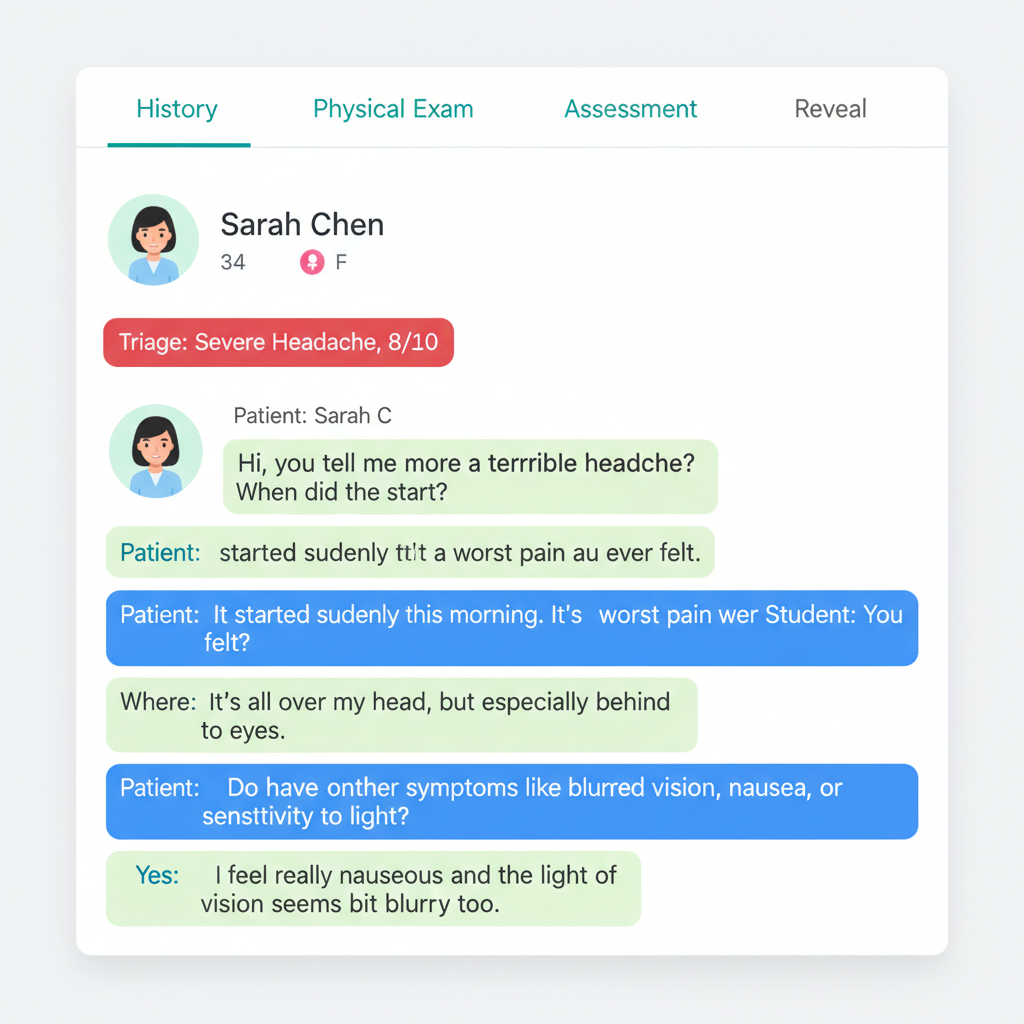
Choose a Simulator
OSCE Trainer screenshot

OSCE Patient Encounter

Simulate a full clinical station — take history from an AI patient, examine them, then order bloods, ECGs, and imaging and see real results correlated to your patient's presentation. Build your differential and management plan, then face Dr. Dwight.

  • AI patient responds in character to your history
  • Order labs, ECGs & imaging — see real results
  • ECG waveform rendered and correlated to the case
  • Dr. Dwight critiques your differential diagnosis
  • Assessment, plan & test ordering all scored
  • Socratic debrief: justify every decision you made
Dr. Dwight says…

"Your differential included PE but you ordered a d-dimer without pre-test probability. Wells score first. Always. Why did you skip the troponin on a chest pain patient? Walk me through your reasoning."

Auscultation Trainer

Hear it. Identify it. Understand it.

Real cardiac audio cases — murmurs, gallops, clicks, and rubs. Listen to the sound, locate it on a cardiac diagram, then identify the diagnosis. Every answer comes with a full clinical explanation.

  • Aortic stenosis, MR, MVP, TR, AR and more
  • Interactive cardiac diagram — click your auscultation site
  • S1/S2 timing, radiation, and grading explained
  • USMLE-style clinical vignettes with each sound
  • Immediate feedback with full pathophysiology
Heart Sounds · Question 3 of 10
Score: 2/2
Clinical context: A 68-year-old man with exertional dyspnoea, angina, and near-syncope. Slow-rising carotid pulse. BP 100/80. What is the most likely valvular lesion?
0:000:04 ▶0:08
Auscultation site:
Aortic
Pulmonic
Tricuspid
Mitral
A.Mitral regurgitation
B.Aortic stenosis
C.Hypertrophic obstructive cardiomyopathy
D.Aortic regurgitation

✓ Correct — Aortic Stenosis

Classic triad: angina, syncope, dyspnoea. Harsh crescendo-decrescendo ejection systolic murmur best heard at the aortic area, radiating to the carotids. Slow-rising ("parvus et tardus") pulse. S2 may be soft or absent as the valve calcifies.
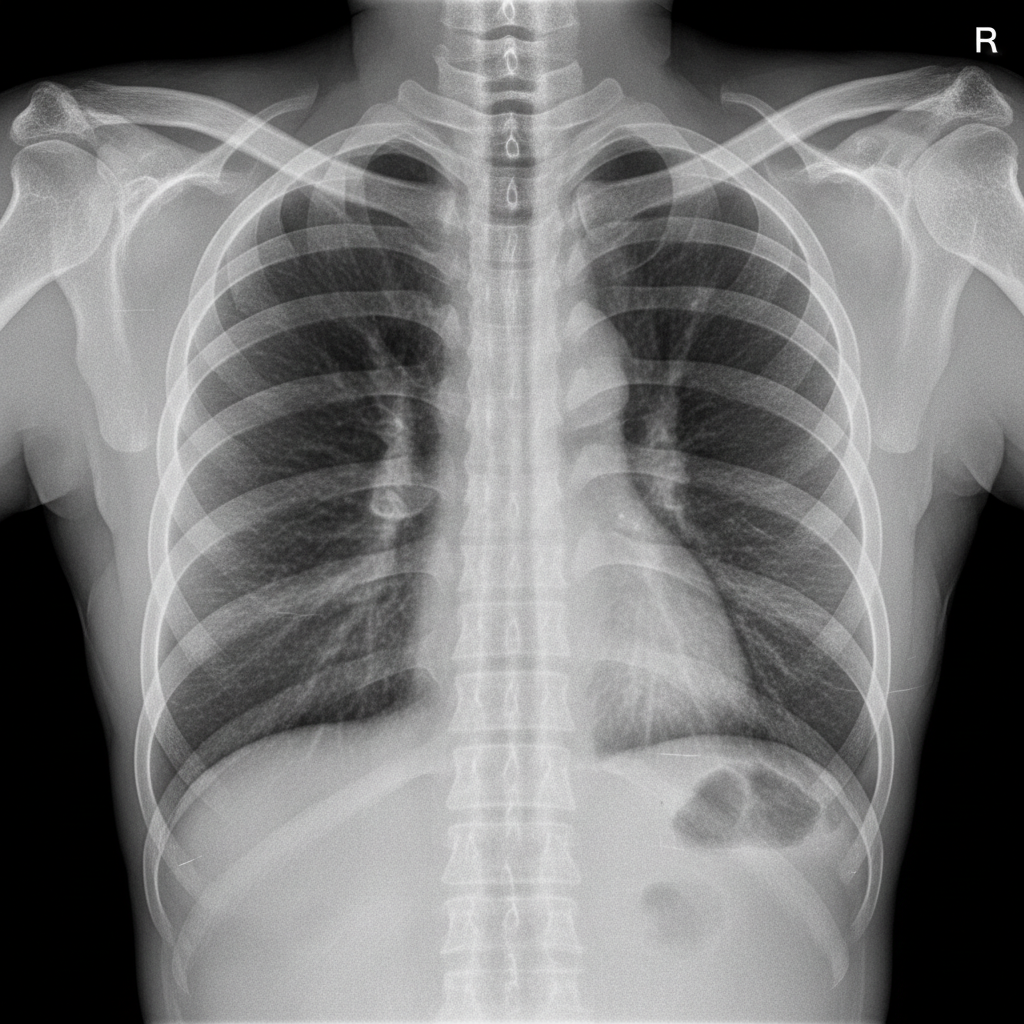
CHEST PA VIEW
ANAMNESIS XRAY TRAINER
Chest X-ray — Cardiomegaly with pulmonary oedema
Cardiac silhouette — CTR > 0.5
Key Signs (hover to locate)
Cardiomegaly (CTR >0.5)Perihilar hazinessBilateral effusionsKerley B lines
Clinical context: A 74-year-old woman with known ischaemic cardiomyopathy presents with 3 days of worsening dyspnoea, orthopnoea, and bilateral leg oedema. What is the most likely finding on this CXR?
A.Tension pneumothorax
B.Acute pulmonary oedema with cardiomegaly
C.Right middle lobe consolidation
D.Massive pleural effusion

✓ Correct — Acute Pulmonary Oedema

Cardiomegaly (CTR >0.5), upper lobe venous diversion, perihilar bat-wing haziness, and bilateral blunted costophrenic angles from effusions. Classic decompensated left heart failure on a background of ischaemic cardiomyopathy.
Radiology Trainer

Read the film. Make the call.

Every question pairs a real AI-generated chest radiograph with a clinical vignette. Hover signs to highlight the region on the image, then answer and see a full structured interpretation.

  • AI-generated radiographs — unique film every time
  • Hover key signs to see highlighted regions
  • Basic recognition & USMLE-style vignette modes
  • Cardiomegaly, oedema, PE signs, congenital disease
  • Structured explanation on every answer
AI Question Generator

From your notes to a full exam — in seconds

Paste your lecture notes or upload a PDF and Anamnesis generates targeted MCQs and SAQs pulled straight from your material. Answer them, get instant AI-graded feedback — then ask Dr. Dwight to explain anything you got wrong.

MMultiple Choice Question
A 45-year-old woman is started on lisinopril for hypertension. Two weeks later she develops a dry, persistent cough. What is the most appropriate next step?
A.Add codeine for cough suppression
B.Switch to an ARB (e.g. losartan)
C.Increase the lisinopril dose
D.Order a chest X-ray
✓ Correct. ACE inhibitors cause bradykinin accumulation → dry cough in ~10–15% of patients. ARBs block the angiotensin II receptor directly and do not cause this side effect.
Score: 1/1 · Tagged from: Pharmacology notes
SShort Answer Question
Explain the pathophysiology of cardiogenic shock and list three immediate management priorities.
Your answer:
"Cardiogenic shock results from pump failure — usually after a large MI. CO drops, SVR rises compensatorily. Priorities: reperfuse with primary PCI, maintain MAP with noradrenaline, and avoid aggressive fluids…"
AI Score7 / 10
Correct pathophysiology — CO/SVR relationship
PCI reperfusion mentioned
⚠Missed: mechanical support (IABP/Impella), inotropes vs vasopressors distinction
Generated from: Cardiology — Acute MI.pdf
Dr. Dwight
Dr. Dwight
Ask me anything — I'll explain it properly
Why do we use noradrenaline over dopamine in cardiogenic shock now?
Dr. Dwight
Good question. The SOAP-II trial showed dopamine increased arrhythmia risk vs noradrenaline. More importantly, dopamine's dose-dependent receptor profile is unpredictable — at low doses it's dopaminergic, at mid doses β1, at high doses α1. Noradrenaline is cleaner: pure α1 + β1, predictable vasoconstriction, better MAP support.
So when would you ever still use dopamine?
Dr. Dwight
Rarely. Bradycardia with hypotension — where you want the chronotropic effect. That's about it. For everything else, noradrenaline is first-line. Now — what's the difference between inotropes and vasopressors and when do you combine them?
Ask Dr. Dwight anything…
→

Available on every question — not just the OSCE

SAQs from your notesUSMLE-style MCQsInstant AI gradingStrengths & gaps flaggedDr. Dwight on every question
Features

Every tool, in one place

AI-Generated Questions
Paste your notes or upload a PDF — get SAQs and MCQs in seconds, tailored to what you're studying.
Smart Flashcards
Auto-generate flashcard decks with spaced repetition (SM-2) built in. Study smarter, not harder.
ECG Trainer
Interpret real 12-lead ECGs with USMLE-style questions and AI-rendered waveforms for every rhythm.
Heart Sound Auscultation
Listen and identify murmurs, gallops, and extra heart sounds with interactive audio cases.
Chest X-Ray Interpretation
AI-generated radiograph cases with structured interpretation questions — from normal films to emergencies.
Pharmacology Trainer
High-yield drug questions covering mechanisms, side effects, and clinical use. Perfect for USMLE Step 1 & 2.
Get Pimped (Oral Exam)
Simulate an oral viva with an AI attending who fires clinical reasoning questions and grades your answers live.
OSCE Patient Encounters
Full simulated OSCE stations — take history, examine, order investigations, and get debriefed by Dr. Dwight.
Residency Dashboard
Track your mastery across every domain — streaks, accuracy trends, practice gaps, and achievement badges.

Ready to study smarter?

Create a free account and generate your first AI-powered test in under 30 seconds.

Focused TechnologiesPowered by Focused Technologies © 2026